
Palantir's pushing forward on reindustrialization and AI across the board. They need talent to keep up, they're positioning themselves as the orchestration layer every AI model runs through, and the partnerships rolling in are getting real. Big month.
March was a busy month for Palantir. AIPCon 9 dropped a pile of partnership announcements, the CTO went on what can only be described as a media tour, and a single LinkedIn recruiting post pulled 1.1 million views. There's a lot to go through here, so I'm going to focus on the stuff that actually matters if you work on or around the platform.
Palantir's Not Selling AI. They're Selling the Layer Everything Runs Through.
The clearest signal from AIPCon 9 was Palantir's positioning. The messaging across the event was consistent: they're not selling AI models. They're selling the orchestration layer that sits between those models and the organizations trying to get actionable decisions out of them. The LLMs, whether from Anthropic, OpenAI, Google, whoever, are components. Replaceable ones.
If you work on Foundry, this framing rings true depending on what you're doing. On the AI side, you're setting up the framework of what you want AI to achieve, selecting which model to use for which task, and orchestrating how everything flows together. Opus 4.6 for coding work, Flash or GPT Minis for quick chatbot responses, something heavier for complex reasoning. You pick strengths and combine them. That part genuinely works like an orchestration layer.
On the non-AI side, it's maybe less "orchestration" and more "all-in-one system." You're doing data ingestion, cleaning, analysis, and actioning all in one place where everything works together. But you're not really orchestrating across different tools. You just don't need anything else. Either way, the point stands: Palantir wants to be the platform everything runs through, and they're building toward that pretty aggressively.
This has been the direction since AIP launched, but models were limited back then. Now with every major LLM improving and more getting added to the platform regularly, the "use the right model for the right job" pitch has real teeth. I've been using Claude for AI FDE work and cheaper models for quick agent responses, and being able to mix and match based on context is genuinely useful.
Centrus Energy: $300 Million in Savings. In Six Weeks.
Centrus Energy's CEO Amir Vexler stood up at AIPCon 9 and said his team had identified nearly $300 million in potential savings since partnering with Palantir in late January. Six weeks. That's a big number to throw around at a conference.
"The nearly $300 million in savings we have identified to date are only the beginning."
Amir Vexler, CEO of Centrus Energy — Centrus Press Release
The partnership covers project controls, engineering, manufacturing execution, supply chain, and regulatory compliance at Centrus's uranium enrichment facility in Piketon, Ohio. Palantir's team described it as "building a unified ontology that connects the Centrus nuclear manufacturing continuum," which in plain terms means connecting all their data together so it works like an orchestra instead of a bunch of separate systems that don't talk to each other.
Are those savings numbers credible? They can be. It depends on how you measure it. Is it reduced human labour? Speed to value? A mix of actual cost savings and theoretical productivity increases? "Identified" savings and "realized" savings are very different things. All savings are case by case, and most of the time you don't really know the full picture until a few months of work. But the fact that Centrus's own CEO is putting his name behind $300M publicly, that carries weight.
Moder and Freedom Mortgage: Ontology Doing What It Does Best
Palantir partnered with Moder to build an AI-powered mortgage operations platform, with Freedom Mortgage as the first pilot customer. The core of it: using Palantir's Ontology to translate mortgage policies and guidelines into configurable, auditable rules that drive agentic AI workflows.
Translation: instead of having humans manually interpret policy documents and apply them to every mortgage file, the system turns those policies into rules that AI agents can follow, with a full audit trail of every decision. In an industry where regulators want to know exactly why a loan was approved or denied, that audit trail matters a lot.
This is exactly the kind of deployment where Ontology shines. Regulated industry, complex document-heavy processes, multiple systems of record that need to talk to each other, and a strong requirement for auditability. Moder has 70+ clients across financial services, so if this pilot works at Freedom Mortgage, that's a pretty large potential rollout.
No competitor is doing this the same way. Databricks and Snowflake have semantic layers that define what data means, but they don't execute operational decisions and maintain an audit trail of which policy rule drove which action. That's a meaningful difference when compliance is on the line.
Ted Mabrey Called the Hobbits Home
Early in March, Ted Mabrey posted a recruiting call on X targeting former Palantir employees. 1.1 million views. The post was straightforward: come back, the work is intense, you'll be on a plane day one, and the only thing promised is purpose and intensity.
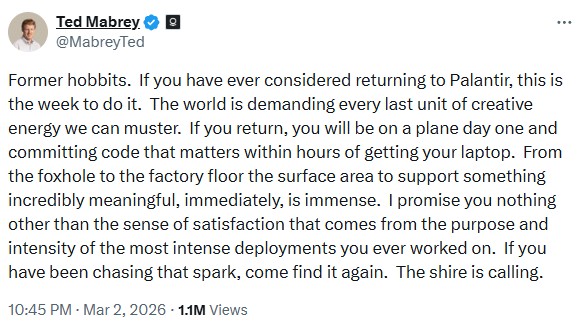
I thought it was interesting. It's a strong calling and it tells you something about where Palantir is right now. They can't train people fast enough to keep up with demand. The skill set needed to be a good FDE is specific and takes time to develop. You have to be multitalented, and it's not necessarily about coming from the best schools but having the right mix of experience.
It created FDEs with character, the Palantir culture does that. But this kind of post is going to call to a specific group: people who left and miss the intensity. It's probably not going to pull back entrepreneurs who left and are putting the same work ethic they got from Palantir into their own thing. Why give that up? But for people who left just to try something new and found it wasn't the same, many will be tempted.
The broader signal is that more demand is coming and Palantir needs the talent pipeline to survive it. The 61% growth guidance they reaffirmed earlier in the month isn't just a number. It requires people.
Sankar's March Media Tour
Shyam Sankar, Palantir's CTO, did six major appearances in two weeks around the release of his book "Mobilize". Hudson Institute, Shawn Ryan Show, CNBC, Fox News, Bloomberg TV alongside Jamie Dimon and OpenAI's Brad Lightcap. That's a lot of airtime for a CTO.
The thesis: North America needs AI to drive real productivity gains if it wants to compete. With declining birth rates and a hollowed-out industrial base, the path forward requires a mix of increased productivity and self-sufficiency. It's a push for Palantir to broaden the market, and the message is that falling behind on AI and industrialization isn't hypothetical, it's happening. Whether you agree with all of it or not, the ambition is clear.
It's a long play. Palantir has immediate demand for talent, but they also need to build a pipeline of enterprises that see AI as an operational necessity, not a nice-to-have experiment. Sankar's out there making that case to every audience that'll listen.
What March Tells Us
Put the orchestration layer positioning, the Sankar media tour, and the Mabrey recruiting push side by side and you see a company that knows what it is and isn't slowing down. Palantir is pushing forward and needs the talent pool to keep up. They're not here to be stagnant. They want to continue being a giant in the AI and data world, and March was them making that very clear to everyone watching.
The partnerships at AIPCon 9 weren't just handshake announcements. Centrus has a CEO putting $300M in savings on the record. Moder has Freedom Mortgage live on the platform. The Nvidia sovereign AI OS gives organizations a full on-prem AI stack with no cloud dependency, something no hyperscaler can offer because their entire business model requires you to stay in their cloud.
If you're building in Foundry or thinking about it, the trajectory is pretty clear. The platform is getting more capable fast, the ecosystem around it is expanding, and the companies deploying it are moving from pilots to production. March was the month Palantir told the world: this is what's coming. Keep up or get left behind.
If your team is trying to figure out where Palantir Foundry fits into your operations, or you're already on the platform and want to get more out of it, this is the kind of messy, real-world problem my team likes to dig into. If you reach out, we'll figure it out together.
